


Integration of refugees into communities and labour markets
An overview of what is known about refugee integration into host country societies based on “The Labor Market Integration of Refugee Migrants in High-Income Countries” by CReAM researchers Courtney Brell, Christian Dustmann, and Ian Preston.
Challenges for refugee integration
Compared to other kinds of migrants, refugees are typically not so well adapted to host countries upon arrival – while other migrants have chosen to move to a specific destination partly based on where they have the best job opportunities etc., refugees often have little choice in moving, little ability to prepare before a move, and little ability to choose their destination to suit their skills and needs.
If refugees are not confident that they will remain in the host country (either because of uncertain legal status or simply because they intend to return to their home country as soon as it is safe to do so), they may not have strong incentives to invest heavily in learning skills that are useful in the host country (such as language).
The specific experiences of refugees, both before and during flight, can also affect their ability to integrate. Refugees tend to have substantially worse health outcomes than other kinds of migrants. Traumatic experiences and uncertainty lead to high prevalence of mental health issues in refugee populations.
How well are refugees integrated into host countries?
Refugees begin their stay in the host country with much lower levels of employment than other kinds of migrants. While the experience varies between host countries, it is typical that over the first few years after migration, refugees experience strong growth in employment rates, indicating that this is a critical time for integration. However, it is also typical that they continue to have lower attachment to the labour force than other migrants for some time after arrival. Evidence suggests that refugees in Europe do eventually approach the employment levels of other migrants, but that this takes more than a decade.
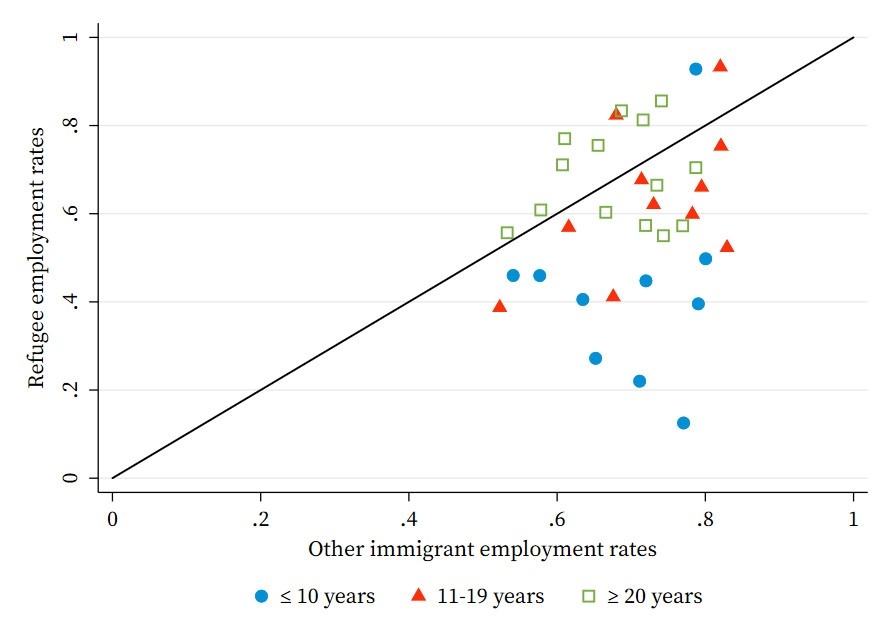
Figure: The employment rates of refugees compared to other immigrants across European countries. Each point represents a country, and if refugees were employed at comparable rates to other immigrants the dots would fall along the 45 degree line. For those in the host country for less than 10 years refugees tend to lag substantially behind other migrants with the same length of residency, but the gap between the groups appears to close over time.
Some demographic subgroups of refugees can have especially large employment gaps compared to analogous non-refugee migrants. Refugee women in particular appear to be much less likely to find a job compared to other migrant women. Women also appear to miss out on the rapid employment gains experienced by refugee men in the early years after arrival. Different origin groups also tend to experience different integration patterns.
Those refugees who do find jobs generally command lower wages than other immigrant groups. As with employment rates, the wage gap between refugees and other migrants does close a little over time, but can remain persistently large even in the long term. This varies considerably between host countries.
Proficiency of refugees in the host country language is both an important marker of integration and an important factor in allowing integration to occur. There is large variation between countries in terms of refugee language proficiency, which has been argued to account for the poor employment outcomes of refugees. Refugees do however improve their language skills over time in the host country.
What policies promote refugee integration?
The placement of refugees is important for their integration. Residing near established social networks of migrants from similar backgrounds appears to improve refugee outcomes, presumably as job opportunities and other useful knowledge can be spread through these channels. However, being placed near other new arrivals can increase competition for scarce suitable jobs and other resources and lead to poorer outcomes. Refugees in areas with more suitable job opportunities will also fare better.
Extended stays in refugee camps or without the legal right to work can make it a challenge for refugees to start working again. Several studies establish a negative effect of waiting in asylum accommodation on future integration outcomes, and similarly it has been found that temporary employment bans for refugees have long-lasting consequences.
Support for the unique health needs – in particular mental health needs – of refugees is also critical for their integration. As well as directly providing access to healthcare, designing policies to avoid making the situation more stressful for refugees can improve their mental health outcomes. Adverse conditions such as living in institutional accommodation and experiencing restricted economic opportunity are risk factors for mental health outcomes. Studies overwhelmingly conclude that the mental health consequences of traumatic experiences can be mitigated by early psychological support, reduced duration in asylum facilities, and support for early absorption into the labour market.
As the paper concludes: “keeping the asylum process short, providing early support to address health issues, and facilitating refugees to join the labour market at the earliest possible stage are of key importance. Such policies reduce skill loss, help to reduce uncertainty about future residence, and improve the effectiveness of human capital investment, thus enhancing incentives to invest.”
To learn more, please read the original research paper.
References
Brell, Courtney, Christian Dustmann, and Ian Preston. 2020. "The Labor Market Integration of Refugee Migrants in High-Income Countries." Journal of Economic Perspectives, 34 (1): 94-121.